
How Long Do Apple AirTags Last? A Complete Guide to Battery Life and Lifespan

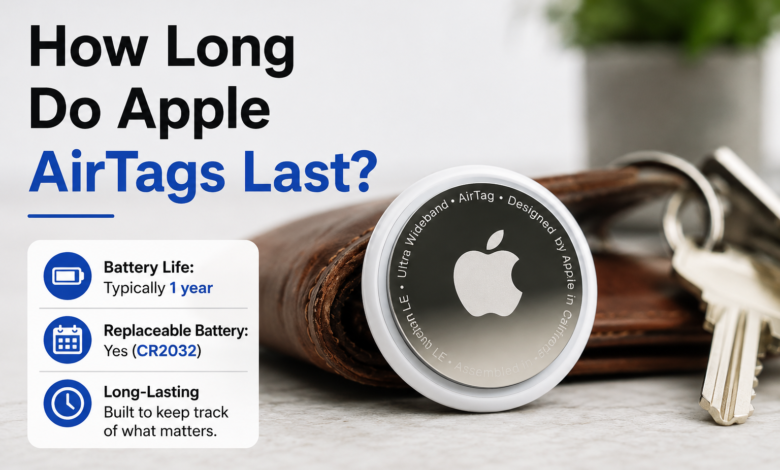
If you’re wondering how long do apple airtags last, the good news is that AirTags are designed to work for a long time with very little maintenance. Apple says an AirTag can work for more than a year on a standard, replaceable battery. When the battery gets low, your iPhone can alert you so that you can replace it instead of replacing the entire AirTag.
That makes the AirTag different from many small tracking devices that need to be charged or thrown away when their internal battery runs out. An AirTag uses a common CR2032 coin-cell battery, which can be replaced by the user. So, while the battery doesn’t last forever, the AirTag itself can continue working through repeated battery replacements.
Apple introduced the original AirTag in 2021, and the AirTag second generation was introduced in 2026. Both generations use a replaceable CR2032 battery and are designed for more than a year of battery life under Apple’s stated usage conditions.
This guide explains battery life, the overall lifespan of an AirTag, signs of a weak battery, replacement steps, factors that affect battery performance, and ways to get the most from your tracker.
How Long Do Apple AirTags Last on One Battery?
The simple answer is more than a year.
Apple describes AirTag as having a battery that lasts for more than a year under normal use. The battery is a CR2032 lithium coin cell, and it can be replaced when it becomes low.
However, “more than a year” shouldn’t be treated as a guarantee that every AirTag will last exactly the same amount of time. Battery performance depends on several conditions. How often you use certain AirTag features, the surrounding temperature, and the quality of the replacement battery can all affect actual battery life.
For example, an AirTag that mostly sits on your luggage may use its battery differently from one attached to your keys that you frequently search for with sound or Precision Finding.
Apple’s technical information also makes it clear that actual battery results can vary according to usage, environmental conditions, and the manufacturer of the replacement battery.
So, if you’re planning ahead, expecting roughly a year or more is a sensible approach. But don’t be surprised if your individual AirTag lasts somewhat longer or shorter.
Does the AirTag Battery Need Charging?
No. This is one of the biggest conveniences of an AirTag.
You don’t plug an AirTag into a charger like you would a smartphone, smartwatch, or wireless earbud case. Instead, it uses a small CR2032 coin-cell battery.
When the battery becomes low, you simply remove the back cover, take out the old battery, and install a new one. Apple provides instructions for doing this without sending the AirTag to a service center.
This design is especially useful for people who attach AirTags to items they don’t want to think about every day. You can put one on a suitcase, backpack, set of keys, or another compatible item and leave it there for a long period.
There’s no charging cable to carry around, no charging port to clean, and no regular charging routine to remember. That’s a big reason why AirTags are convenient for everyday item tracking.
How Long Does the AirTag Itself Last?
Battery life and product lifespan are two different things.
When people ask how long do apple airtags last, they may actually be asking two questions:
- How long does the battery last?
- How long can the AirTag itself remain useful?
The battery generally lasts more than a year, but the AirTag itself doesn’t become useless simply because the original battery dies. You can replace the CR2032 battery and continue using the device.
There isn’t a simple official expiration date for the AirTag hardware. Its practical lifespan depends on its physical condition, battery compartment, electronics, exposure to water or extreme conditions, and continued compatibility with Apple’s software and services.
An AirTag that’s protected from serious physical damage and used normally can therefore remain useful through multiple battery replacements.
In other words, you shouldn’t think of an AirTag as a one-year product. Think of the one-year figure as a battery replacement interval, not an expiration date for the tracker.
AirTag Battery Life at a Glance
The following table provides a quick overview of the important points:
| Feature | AirTag Information |
|---|---|
| Typical battery expectation | More than a year |
| Battery type | CR2032 lithium coin cell |
| Battery rechargeable | No |
| Battery replaceable | Yes |
| Replacement method | User replaceable |
| Low-battery warning | iPhone notification |
| Battery check | Find My app |
| Original AirTag introduced | 2021 |
| AirTag second generation | Introduced in 2026 |
| Water and dust resistance | IP67 under laboratory conditions |
| Charging cable required | No |
| Entire AirTag replaced when battery dies | No |
Apple confirms that AirTag uses a user-replaceable CR2032 battery. The device is also rated IP67 for splash, water, and dust resistance under controlled laboratory conditions.
What Type of Battery Does an AirTag Use?
AirTag uses a CR2032 lithium three-volt coin-cell battery.
This battery type is widely available from electronics stores, pharmacies, and other retailers. Apple specifically recommends using a compatible CR2032 battery and warns that some bitterant-coated batteries may not work correctly with AirTag.
When buying a replacement, look for packaging that clearly states compatibility with Apple AirTag.
A good replacement battery should:
- Be the correct CR2032 type.
- Have the correct voltage rating.
- Be from a reliable manufacturer.
- Be compatible with AirTag.
- Be installed with the positive side facing upward.
It’s also important to keep coin-cell batteries away from children. Small lithium batteries can be extremely dangerous if swallowed. Apple specifically highlights this safety concern in its battery replacement instructions.
How Do You Know When an AirTag Battery Is Low?
You don’t have to guess when the battery needs replacing.
Your iPhone can notify you when the AirTag battery is low. You can also manually check the AirTag through the Find My app.
To check it:
- Open the Find My app.
- Select the Items tab.
- Select the AirTag you want to check.
- Look for a low-battery message beneath the AirTag’s name.
If the battery is low, the app can tell you that it’s time to replace it.
This is a helpful feature because you don’t need to open the AirTag regularly just to inspect the battery. Instead, your iPhone acts as a reminder.
That can be especially useful if your AirTag is attached to luggage, a travel bag, or another item that you don’t use every day.
How to Replace an AirTag Battery
Replacing an AirTag battery is a straightforward process.
Apple’s current instructions involve removing the stainless-steel battery cover, taking out the old battery, and inserting a new CR2032 battery.
Here is the basic process:
Remove the Back Cover
Press down on the polished stainless-steel cover.
While pressing, rotate the cover counterclockwise until it stops.
Then remove the cover.
Take Out the Old Battery
Remove the old CR2032 battery carefully.
Don’t use excessive force, and don’t damage the battery.
Insert the New Battery
Place a compatible CR2032 lithium battery inside the AirTag with the positive side facing upward.
You should hear a sound indicating that the battery has connected.
Put the Cover Back
Align the three tabs on the cover with the three slots on the AirTag.
Then rotate the cover clockwise until it locks into position.
That’s it. Your AirTag should be ready to use again.
What Can Make an AirTag Battery Drain Faster?
Although Apple rates the battery for more than a year, real-world usage can vary.
Several factors can influence battery performance.
Frequent Sound Playback
Every time you use the AirTag’s speaker to help locate an item, the device uses energy.
Occasional sound playback isn’t usually something to worry about. But frequent searches can contribute to higher battery consumption.
If you’re constantly asking the AirTag to play a sound, its battery may not last as long as one that’s rarely used.
Frequent Precision Finding
Precision Finding is another feature that can affect power use.
The original AirTag’s published battery testing was based on everyday use that included four sound events and one Precision Finding event per day. Apple notes that actual results vary.
The second-generation AirTag also has battery-life testing based on everyday average use involving sound and Precision Finding. Apple again warns that real-world results can vary.
So, if you use finding features very frequently, you shouldn’t expect exactly the same battery performance as someone who rarely searches for an item.
Temperature
Temperature can also influence battery performance.
Apple lists an operating ambient temperature range for AirTag of approximately -20°C to 60°C.
Very cold or very hot environments aren’t ideal for small electronic devices or coin-cell batteries.
For example, an AirTag left inside a vehicle exposed to extreme temperatures may experience conditions that aren’t the same as normal indoor use.
Battery Quality
Not every CR2032 battery will perform identically.
Apple specifically notes that battery life can vary depending on the replacement battery manufacturer.
That’s why buying a reliable, compatible battery is a smart choice.
A cheap battery may seem like a bargain, but saving a small amount of money isn’t worthwhile if the battery performs poorly or isn’t properly compatible.
Does AirTag Two Last Longer Than the Original AirTag?
The second-generation AirTag was introduced in 2026 and brings hardware improvements such as a second-generation Ultra Wideband chip, expanded Precision Finding capabilities, and an upgraded speaker.
However, Apple still describes the second-generation AirTag as working for more than a year on a standard replaceable battery.
This is important because it’s easy to assume that newer hardware must automatically have significantly longer battery life. That’s not necessarily true.
Apple’s published information gives the second-generation AirTag a more-than-a-year battery-life rating, while also explaining that battery performance varies according to usage and environmental conditions.
Therefore, it’s better to use Apple’s published battery rating rather than making unsupported claims about one generation lasting dramatically longer than another.
How Long Do Apple AirTags Last in Storage?
An AirTag that’s sitting unused may not behave exactly like one that’s actively being used.
The installed CR2032 battery can slowly lose charge over time, even when the device isn’t being used heavily. Battery age, storage temperature, and the condition of the battery can all matter.
If you’re storing an AirTag for a long period, keep it in a reasonable environment rather than exposing it to extreme heat, extreme cold, moisture, or damaging conditions.
It’s also wise to check the battery before relying on an AirTag for an important trip.
For example, if you haven’t used a travel AirTag for many months and you’re about to put it inside expensive luggage, check the Find My app first. A quick battery check can prevent an unpleasant surprise at the airport.
Can You Use an AirTag While Traveling?
Yes. AirTags are particularly useful for travel.
Many people attach them to:
- Suitcases
- Backpacks
- Carry-on bags
- Camera bags
- Laptop bags
- Key cases
- Travel organizers
- Other valuable personal belongings
The AirTag can work with Apple’s Find My network, allowing compatible Apple devices to help report the approximate location of an AirTag.
The second-generation AirTag also offers expanded Precision Finding capabilities compared with the original model.
However, travelers should still understand that an AirTag isn’t a substitute for airline baggage systems, insurance, or careful packing.
It’s best viewed as an additional tracking tool.
Is an AirTag Waterproof?
AirTag is officially rated IP67 for splash, water, and dust resistance under controlled laboratory conditions. Apple says this rating covers immersion up to one meter for up to thirty minutes under the applicable test conditions.
But there’s an important detail here: water resistance isn’t permanent.
Apple explains that resistance can decrease through normal wear.
So, while an AirTag can handle everyday situations such as rain or an accidental splash, you shouldn’t treat it as an underwater device.
If your AirTag becomes wet, follow Apple’s safety and handling guidance and make sure it is appropriately dried before continued use.
Does Water Damage Reduce the AirTag’s Lifespan?
It can.
Although the AirTag has an IP67 rating, physical damage, wear, and repeated exposure to difficult conditions can affect the device.
For example, an AirTag attached to outdoor equipment may experience more stress than one kept on an indoor set of keys.
Drops, crushing, extreme heat, liquid exposure, and other forms of damage can potentially affect electronic components. Apple’s safety documentation advises users not to use a damaged AirTag.
That’s why taking reasonable care of the tracker can help it remain useful for longer.
A protective accessory can also be helpful when the AirTag is attached to an item that gets knocked around frequently.
Ways to Make Your AirTag Last Longer
Getting more life from an AirTag doesn’t require complicated maintenance.
A few simple habits can help.
Use a Quality Replacement Battery
Choose a compatible CR2032 battery from a trusted manufacturer.
Don’t assume that every coin-cell battery will perform exactly the same way.
Avoid Extreme Conditions
Try not to leave the AirTag exposed unnecessarily to extreme heat, extreme cold, or harsh chemicals.
Don’t Abuse the Device
AirTag is small and convenient, but it isn’t indestructible.
Avoid dropping, crushing, puncturing, opening, or modifying it.
Check Find My Occasionally
Checking the battery status occasionally is a smart habit, especially before travel.
Replace the Battery Promptly
If your iPhone shows a low-battery warning, don’t ignore it for months.
Replace the battery when convenient so the tracker is ready when you need it.
Original AirTag vs Second-Generation AirTag
The second-generation AirTag arrived in 2026, so shoppers now have a newer generation to consider.
| Feature | Original AirTag | AirTag Second Generation |
|---|---|---|
| Introduction | 2021 | 2026 |
| Battery | CR2032 | CR2032 |
| Battery replaceable | Yes | Yes |
| Battery expectation | More than a year | More than a year |
| Precision Finding | Yes | Expanded capabilities |
| Ultra Wideband | Apple U1 chip | Second-generation chip |
| Speaker | Built-in | Upgraded |
| Water resistance | IP67 | IP67 |
| Find My support | Yes | Yes |
Both models are designed around a replaceable coin-cell battery. The second generation adds hardware and finding improvements, but its published battery expectation remains more than a year.
What Happens When an AirTag Battery Dies?
An AirTag can’t continue tracking normally once its battery is completely depleted.
The important thing is that this doesn’t mean the AirTag itself has reached the end of its useful life.
You can replace the battery.
After installing a new compatible CR2032 cell, the AirTag can be used again.
This is one of the strongest practical advantages of the AirTag design. Instead of throwing away the entire tracker when its battery runs out, you replace only the small battery.
That can save money over time and also reduce unnecessary electronic waste.
Common Mistakes to Avoid When Replacing the Battery
Battery replacement is easy, but there are still a few things to keep in mind.
Avoid these mistakes:
- Installing the battery upside down.
- Using the wrong battery type.
- Forcing the battery into the compartment.
- Damaging the battery.
- Using a battery that isn’t compatible with AirTag.
- Leaving loose coin batteries around children.
- Failing to close the AirTag cover properly.
- Ignoring a low-battery warning for too long.
Apple says the replacement CR2032 battery should be installed with the positive side facing upward.
Apple also warns that some bitterant-coated CR2032 batteries may not work with AirTag. Therefore, check the packaging for compatibility rather than assuming every CR2032 cell is suitable.
Is There a Monthly Fee for AirTag?
AirTag isn’t designed around a monthly tracking subscription.
The device works with Apple’s Find My ecosystem rather than requiring you to pay a monthly cellular tracking charge.
This makes it different from some GPS trackers that use cellular networks and may require an ongoing service plan.
Of course, you still need compatible Apple hardware and software to use the relevant Find My features, and some advanced features have specific compatibility requirements.
For most people, however, the appeal is simple: buy the AirTag, install it, attach it to an item, and replace the coin-cell battery when necessary.
How Long Do Apple AirTags Last for Everyday Users?
For a typical user, the answer is encouraging.
If you attach an AirTag to your keys, luggage, backpack, or another item and use it normally, you can expect the installed battery to last more than a year, according to Apple.
After that, you replace the battery rather than replacing the AirTag.
The actual life of the hardware can be much longer than one battery cycle. There isn’t a simple one-year expiration date on the device.
Its useful life depends on physical condition, battery replacement, environmental exposure, software compatibility, and how well you care for it.
That’s why an AirTag can be a practical long-term tracking accessory.
Frequently Asked Questions About How Long Do Apple AirTags Last
How long do apple airtags last on one battery?
Apple says an AirTag works for more than a year on a standard battery. Actual battery life can vary depending on usage, environmental conditions, and the replacement battery manufacturer.
Can I replace the AirTag battery myself?
Yes. AirTag uses a user-replaceable CR2032 coin-cell battery. Apple provides instructions for removing the cover and installing a replacement.
Does AirTag need to be charged?
No. AirTag doesn’t use a rechargeable battery. It uses a replaceable CR2032 coin cell.
How will I know the battery is low?
Your iPhone can display a low-battery notification. You can also check the AirTag through the Items section of the Find My app.
Can an AirTag last several years?
The battery needs replacement periodically, but the AirTag itself isn’t designed to be discarded after one year. With battery replacement and reasonable care, the hardware can continue being useful.
Does the second-generation AirTag have better battery life?
Apple states that the second-generation AirTag works for more than a year on a standard battery. Apple also notes that actual results vary with usage and environmental conditions.
What battery does AirTag use?
AirTag uses a CR2032 lithium coin-cell battery.
Is AirTag waterproof?
AirTag has an IP67 water, splash, and dust resistance rating under controlled laboratory conditions. However, Apple notes that resistance can decrease with normal wear.
Final Thoughts on How Long Do Apple AirTags Last
So, how long do apple airtags last? The clearest answer is that the AirTag battery is designed to work for more than a year, while the AirTag itself can continue working after the battery is replaced. Apple uses a replaceable CR2032 coin-cell battery, so you don’t have to throw away the tracker when its first battery becomes empty.
The exact battery life will depend on how you use the AirTag, how often you activate sound and finding features, the environment where it operates, and the quality of the replacement battery. Apple specifically states that actual battery results can vary.
The arrival of the second-generation AirTag in 2026 also shows that Apple’s small tracker continues to evolve. The newer model adds improved finding technology and an upgraded speaker while retaining the convenient replaceable CR2032 design.
For everyday users, the message is simple: how long do apple airtags last isn’t really limited to one year. Think of one year as a useful battery-life expectation, not the end of the AirTag’s life. Replace the battery when your iPhone warns you, use a compatible CR2032 cell, protect the device from unnecessary damage and extreme conditions, and your AirTag can remain a useful companion for tracking the things that matter most.
You may also read
Max Bemis: The Musician, Songwriter, and Comic Book Creator Behind Say Anything
