
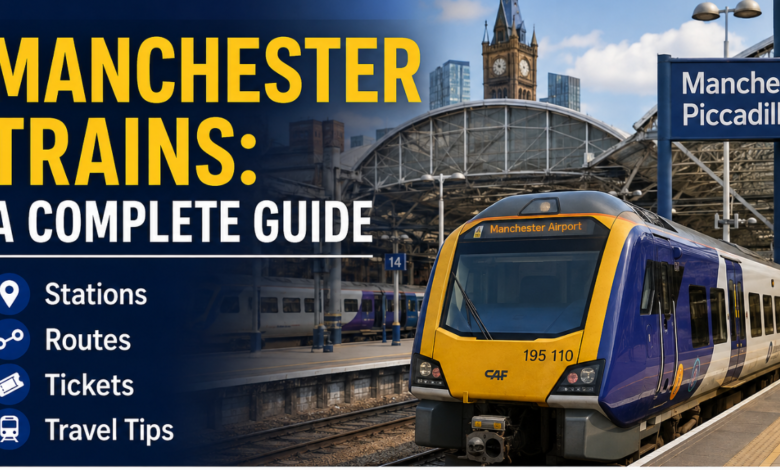

Introduction to manchester trains
Manchester trains are an important part of travel across Manchester, Greater Manchester, and many other parts of the United Kingdom. Every day, people use trains to travel to work, attend university, visit family, enjoy football matches, explore attractions, or connect with other cities. With several major railway stations and many routes, Manchester is one of the most useful rail hubs in northern England.
For visitors, understanding manchester trains can make a journey much easier. Manchester has four main city-centre railway stations: Manchester Piccadilly, Manchester Victoria, Manchester Oxford Road, and Manchester Deansgate. Each station has its own routes, facilities, and nearby attractions.
The rail network also connects Manchester with places such as Liverpool, Leeds, Sheffield, Birmingham, London, Chester, Blackpool, and many other destinations. This means travellers don’t always need a car to explore the region.
Whether you’re a first-time visitor or a regular passenger, learning how manchester trains work can help you save time, choose the right station, and make smarter ticket decisions.
Why manchester trains are important
Manchester has developed into a major business, education, entertainment, and cultural centre. As the city has grown, its railway network has become an essential part of everyday life.
Trains provide a practical way to move large numbers of people without relying entirely on private cars. For commuters, this can mean a more predictable journey into the city. For tourists, trains can open the door to nearby towns and cities without the stress of driving or finding parking.
Manchester’s central railway stations also make it possible to connect different parts of the country. National Rail lists direct or regular connections from Manchester to destinations including Liverpool, Chester, Stockport, Blackpool, Crewe, Birmingham, Oxford, Southampton, and Cardiff. London also has direct daily services from Manchester Piccadilly.
There are several reasons travellers choose manchester trains:
- Convenient connections to major UK cities
- Useful services for daily commuters
- Access to airports and other transport links
- Connections with universities and business districts
- Easy travel for football and music events
- Opportunities for car-free day trips
- Links to local buses, trams, taxis, and other transport
In short, Manchester’s rail network isn’t simply about getting from one station to another. It’s part of the wider transport system that keeps the city connected.
Manchester’s main railway stations
One of the most important things to understand about manchester trains is that there isn’t just one central station.
The four main stations in the city centre are Manchester Piccadilly, Manchester Victoria, Manchester Oxford Road, and Manchester Deansgate. National Rail identifies these as the key stations for arriving in and travelling around central Manchester.
Manchester Piccadilly
Manchester Piccadilly is the city’s principal railway station and one of its busiest transport hubs. It serves a wide selection of local, regional, and longer-distance journeys.
Passengers can find connections to destinations such as London, Liverpool, Birmingham, Oxford, Cardiff, Stockport, Chester, Blackpool, and other locations.
The station also provides links with buses, trams, taxis, and other transport options. National Rail currently lists step-free access to all platforms, lifts, toilets, accessible facilities, refreshments, shops, Wi-Fi, and a First Class lounge among its facilities.
If you’re travelling to Manchester for the first time, Piccadilly is often the station you’ll encounter for longer-distance journeys.
Manchester Victoria
Manchester Victoria is another major station, particularly useful for services toward northern and western destinations.
National Rail lists routes from Victoria toward Blackburn, Chester, Wigan, Leeds, and Liverpool.
The station has step-free access to all platforms, lifts, seating areas, refreshments, toilets, and links to trams, buses, taxis, and rail replacement services.
Victoria is also well placed for several central attractions, making it a practical arrival point for visitors exploring the city.
Manchester Oxford Road
Manchester Oxford Road is especially useful for journeys involving the southern and western parts of the city centre and destinations beyond Manchester.
National Rail lists services from Oxford Road toward places such as Blackpool, Liverpool, Nottingham, Cleethorpes, and Middlesbrough.
The station provides lifts, toilets, accessible facilities, refreshments, staff assistance, bus and tram connections, and other passenger services. However, accessibility can vary by platform because of the station’s layout, so passengers with specific mobility requirements should check the latest station information before travelling.
Manchester Deansgate
Manchester Deansgate is another central station and can be particularly handy for people visiting the western side of the city centre.
National Rail lists connections from Deansgate toward Liverpool, Blackpool, Southport, and Barrow-in-Furness.
Its location makes it useful for visitors heading toward Manchester’s museums, universities, shopping areas, entertainment venues, and business districts.
Manchester trains and popular destinations
One of the biggest advantages of travelling by rail from Manchester is the variety of destinations available.
Manchester is well positioned in northern England, so passengers can reach many important locations relatively quickly. The exact journey time depends on the service, time of day, engineering work, and whether a change is required.
National Rail currently gives example fastest journey times of around 36 minutes between Liverpool and Manchester, 29 minutes between Huddersfield and Manchester, 50 minutes between Chester and Manchester, and around 1 hour 28 minutes between Birmingham and Manchester. Its example fastest time from London to Manchester is around 2 hours 6 minutes.
Here’s a helpful overview:
| Destination | Approximate fastest journey from Manchester* | Why people travel |
|---|---|---|
| Liverpool | Around 36 minutes | Culture, shopping, football, waterfront |
| Huddersfield | Around 29 minutes | Town centre, countryside access |
| Chester | Around 50 minutes | Historic attractions and shopping |
| Birmingham | Around 1 hour 28 minutes | Business, shopping, events |
| London | Around 2 hours 6 minutes | Business, tourism, major events |
| Edinburgh | Around 3 hours 14 minutes | Tourism, history, culture |
| Cardiff | Around 3 hours 19 minutes | City breaks and events |
*Journey times vary by service, date, and route. Some journeys require a change.
These connections make manchester trains attractive for both short trips and longer adventures.
Manchester trains for commuters
For many local residents, trains aren’t mainly about holidays. They’re part of the daily routine.
Thousands of passengers use rail services to reach workplaces, universities, schools, hospitals, shopping districts, and other destinations. A person living outside Manchester might take a train into the city each morning and return home in the evening.
Commuting by train can offer several benefits:
- No need to deal with city-centre parking
- Time to read, work, or relax
- Connections with other public transport
- Reduced dependence on private cars
- Easier access to central business areas
However, commuters should also be realistic. Peak periods can be busy, and delays or cancellations can affect plans. During busy times, allowing extra travel time is a sensible approach.
Recent disruption in August 2026 showed how important Manchester’s rail infrastructure is. A major power failure at the Manchester Rail Operating Centre affected signalling and caused widespread delays and cancellations across north-west England. Services operated by several companies were affected, demonstrating why passengers should check live journey information before travelling.
So, while manchester trains can be convenient, checking the day’s service is always a good habit.
Manchester trains for tourists and visitors
Manchester is a popular destination for tourists because it combines history, music, sport, food, shopping, art, and modern city life.
Arriving by train can be particularly convenient because the main stations are close to many central attractions.
Visitors may use manchester trains to reach:
- Football stadiums and sports venues
- Museums and galleries
- Shopping districts
- Restaurants and cafés
- Concert and entertainment venues
- Universities
- Hotels and business centres
- Historic neighbourhoods
The best station depends on where you’re going. For example, Piccadilly may be the natural choice for a long-distance arrival, while Victoria or Deansgate may be more convenient for certain central destinations.
Before leaving the station, it’s worth checking your onward route. Manchester has buses, trams, taxis, walking routes, and other connections, so the train is often only one part of the journey.
And here’s a useful little trick: don’t automatically assume the biggest station is always the closest one to your final destination. A smaller central station can sometimes save you a surprisingly long walk.
How to choose the right Manchester station
Choosing the correct station can make your journey smoother.
Start by checking your ticket and train details. The station shown on your booking is important because Manchester’s central stations aren’t identical.
Consider these factors:
Your destination: Look at which station is closest to where you’re actually going.
Your train operator: Different operators and routes use different stations.
Your connection: If you’re changing trains, check whether you need to move between stations or platforms.
Your accessibility needs: Check station accessibility information in advance if you require step-free access or assistance.
Your onward transport: Look at bus and tram connections before you arrive.
National Rail provides station information and journey-planning tools that can help passengers understand the available options.
Buying tickets for manchester trains
Buying the right ticket can make a noticeable difference to the cost of your trip.
Several factors can influence the fare, including the travel date, time, flexibility, route, and ticket type. Advance tickets can sometimes offer lower prices when purchased early, although they’re generally tied to a particular service.
National Rail also notes that Railcards can reduce many rail fares by up to one-third, subject to the applicable conditions.
When booking, consider:
- Compare different departure times
- Check whether the ticket is flexible
- Look at Advance fares
- Check Railcard eligibility
- Make sure you choose the correct station
- Read restrictions before buying
- Check whether a return ticket provides better value
If your plans are fixed, an Advance ticket can be worth investigating. If your schedule could change, paying more for flexibility may be the safer choice.
The cheapest ticket isn’t always the best ticket. A slightly more flexible option could save you stress if your plans change.
Understanding train operators in Manchester
Manchester’s railway network involves different train operators and services. Depending on your destination, you may encounter companies such as Northern, TransPennine Express, Avanti West Coast, CrossCountry, East Midlands Railway, and others.
The operator matters because it can affect:
- Train type
- Route
- Ticket conditions
- Onboard facilities
- Service updates
- Customer support
- Connections
This doesn’t mean passengers need to become railway experts. Far from it. Your journey planner and ticket should provide the main information you need.
Still, knowing the operator can be useful if there’s a disruption. If your service is cancelled, checking the operator’s latest travel advice can help you understand what to do next.
Manchester trains and accessibility
Accessible travel is an important part of a modern railway system.
Passengers with mobility challenges, visual impairments, hearing difficulties, or other needs may require additional support. National Rail provides Passenger Assist, which can help passengers who need assistance when travelling.
Station facilities vary, however. Manchester Piccadilly is currently listed as having step-free access to all platforms, while Manchester Oxford Road has some limitations because of its station layout.
Before travelling, passengers who need accessibility support should:
- Check the station’s accessibility information
- Request assistance where appropriate
- Arrive with enough time
- Confirm platform information
- Ask station staff for help if needed
- Check whether a lift or accessible route is available
A little planning can make a big difference. Don’t hesitate to ask for help when you need it.
Manchester trains and day trips
Manchester is an excellent base for exploring northern England.
Because the city has strong rail connections, travellers can plan day trips without renting a car. Depending on the route and timetable, passengers can visit historic cities, coastal destinations, cultural centres, and scenic areas.
Popular ideas include:
Liverpool
Liverpool is one of the easiest major city trips from Manchester by train. It’s famous for music, maritime history, football, museums, shopping, and its waterfront.
Chester
Chester is known for its Roman history, old city walls, distinctive architecture, and shopping streets. It can be a lovely choice for a relaxed day away from the busy city.
Leeds
Leeds offers shopping, food, culture, nightlife, and business attractions. It is also an important city in Yorkshire.
Sheffield
Sheffield is a useful destination for city visitors and people interested in nearby countryside. Its location also provides access to areas around the Peak District.
Blackpool
For travellers who enjoy the seaside, Blackpool can be an entertaining choice. Its famous promenade, attractions, and traditional seaside atmosphere make it popular with visitors.
The exact timetable and fastest route can change, so always check current journey information before setting off.
Manchester trains during busy events
Manchester regularly hosts major sporting fixtures, concerts, festivals, conferences, and cultural events.
During a large event, train stations can become much busier than usual. This is especially true around football matches and major concerts.
If you’re attending an event, don’t simply check the outbound train. Plan the return trip too.
Useful steps include:
- Check the event finishing time
- Look at the last suitable train
- Allow time to leave the venue
- Expect queues at stations
- Buy tickets in advance when appropriate
- Check for engineering work
- Keep your phone charged
- Have an alternative route in mind
During particularly busy events, a journey that normally feels easy can take much longer.
As the saying goes, better safe than sorry.
How to check Manchester train times
Train schedules can change because of engineering work, weather, operational problems, special events, or unexpected incidents.
For this reason, travellers shouldn’t rely entirely on an old timetable or a search result from a previous trip.
National Rail provides journey planning and live travel information for passengers.
Before leaving home, check:
- Departure time
- Arrival time
- Departure station
- Platform information
- Train operator
- Any changes
- Planned engineering work
- Delays or cancellations
- Connection times
Checking shortly before departure is especially important when travelling long distances.
What to do if manchester trains are delayed
Even the best-planned trip can go wrong.
A delay may be caused by signalling problems, equipment failure, weather, congestion, staff issues, or other unexpected circumstances. In August 2026, a major signalling-related power failure caused widespread disruption around Manchester and across parts of north-west England.
If your train is delayed or cancelled, stay calm and check official travel information.
You can then:
- Check whether your train is still running
- Look for an alternative service
- Ask staff about the next available route
- Check whether your ticket remains valid
- Keep evidence of significant delays
- Review the operator’s delay compensation policy
Don’t immediately jump onto a different train without checking the ticket rules. Some tickets have restrictions.
If disruption is serious, staff and official journey-planning systems should be your first sources of information.
Making manchester trains more comfortable
A train journey doesn’t have to feel stressful.
A little preparation can make the experience much more comfortable. If you’re travelling for several hours, think about what you’ll need before boarding.
Consider carrying:
- A charged phone
- Power bank
- Headphones
- Water
- Light snacks
- Travel documents
- Ticket information
- Necessary medication
- A small amount of entertainment
For longer journeys, choose your seat carefully if seat reservations are available. If you’re travelling with luggage, keep it secure and avoid blocking aisles or doors.
During busy periods, travel outside the busiest commuting hours if your schedule allows. It can make a world of difference.
Manchester trains and environmentally friendly travel
Rail travel can be an attractive alternative to travelling by private car, particularly for journeys into busy city centres.
A train can carry many passengers at once, which can reduce the need for large numbers of separate car journeys. National Rail also promotes train travel as a way of reducing carbon emissions compared with some other forms of transport.
For travellers who want to make more sustainable choices, trains can therefore be an important part of a wider travel plan.
You can make your trip even more efficient by combining rail with walking, cycling, buses, or trams where practical.
Useful tips for first-time Manchester train travellers
If you’ve never used manchester trains before, don’t worry. The system might seem complicated at first, but it becomes much easier once you understand the basics.
Keep these tips in mind:
- Check your station before leaving
- Arrive early if you’re unfamiliar with the station
- Keep your ticket easy to access
- Check the departure board regularly
- Listen for platform announcements
- Don’t assume every Manchester train leaves from Piccadilly
- Check your route if you’re changing trains
- Allow extra time during major events
- Keep valuables secure
- Check live information before travelling
Most importantly, ask station staff if you’re unsure about something. There’s no prize for pretending you know the way when you don’t!
A simple Manchester train planning checklist
A quick checklist can prevent many common travel problems.
| Travel step | What to check |
|---|---|
| Before booking | Destination, station, date, and ticket type |
| After booking | Train time, operator, restrictions |
| Before leaving | Delays, cancellations, engineering work |
| At the station | Departure board and platform |
| During travel | Connections and arrival information |
| After arrival | Bus, tram, taxi, or walking route |
| If disrupted | Official updates and alternative services |
This approach is simple, but it works.
Good planning doesn’t mean expecting everything to go perfectly. Instead, it means being prepared if something changes.
The future of manchester trains
Manchester’s importance as a transport hub is likely to remain strong.
The city continues to attract businesses, students, tourists, sports fans, and residents. As demand for public transport grows, reliable railway services will remain essential.
Future improvements across the wider rail system can potentially bring benefits such as:
- Better passenger information
- More reliable services
- Improved accessibility
- Modern trains
- Better connections
- More efficient ticketing
- Improved station facilities
- Stronger integration with other public transport
At the same time, rail networks face challenges. Busy infrastructure, limited capacity, engineering work, and unexpected technical failures can all affect services.
Recent disruption in the Manchester area is a reminder that railway systems depend on complex signalling and operational infrastructure.
Even so, the long-term role of rail travel remains highly valuable. With continued investment and careful planning, Manchester can maintain its position as a major transport centre.
Manchester trains: Key facts at a glance
For quick reference, here’s a summary of the most important points:
| Feature | Information |
|---|---|
| Main city-centre stations | Piccadilly, Victoria, Oxford Road, Deansgate |
| Major long-distance hub | Manchester Piccadilly |
| Important northern hub | Manchester Victoria |
| Useful central stations | Oxford Road and Deansgate |
| Major connections | Liverpool, Leeds, Birmingham, London, Chester, Blackpool and more |
| Ticket options | Advance, flexible, season and other ticket types |
| Money-saving option | Railcards can provide discounts for eligible passengers |
| Accessibility | Facilities vary by station |
| Journey planning | Check current National Rail information |
| Best travel habit | Check live updates before departure |
Final thoughts on manchester trains
Manchester has one of the most useful rail networks in northern England, and manchester trains make it possible to connect the city with nearby communities as well as major destinations across Britain. From Manchester Piccadilly and Victoria to Oxford Road and Deansgate, each station plays an important role in keeping passengers moving.
The biggest lesson is simple: know your station, check your route, choose your ticket carefully, and look at live travel information before leaving. These small steps can turn a confusing journey into a smooth one.
Whether you’re commuting to work, visiting Manchester for a football match, planning a day trip to Liverpool, travelling to London, or simply exploring the North of England, the railway gives you plenty of opportunities.
Of course, no transport network is perfect. Delays can happen, stations can become crowded, and unexpected technical problems can disrupt services. Recent events have shown why checking official updates is so important.
Still, the overall value of manchester trains is clear. They connect people, support businesses, help visitors discover new places, and provide an important alternative to travelling everywhere by car. With sensible planning and up-to-date travel information, passengers can enjoy a more confident, convenient, and rewarding journey with manchester trains.
You may also read
amy carter: Life, White House Childhood, Education, Activism, and Legacy
